Welcome

"So come lose your life for a carpenter's son
For a madman who died for a dream
And you'll have the faith His first followers had
And you'll feel the weight of the beam"--Michael Card
Showing posts with label theology. Show all posts

Monday, June 22, 2015

Glory

filled with the fruit of righteousness that comes through Jesus Christ, to the glory and praise of God. (Philippians 1:11 ESV)
What is God's motivation? Why does God do what he does? The short answer is that God does everything that he does for his own glory.

Be honest. That comes across as egotistical, doesn't it? I mean, who does God think that he is . . . ?

Well, he's God.

The reason why we initially shrink back from the idea that God does everything for his own glory, that God's purpose in all that he does is to glorify himself, is because when we as humans behave this way we are behaving badly. We are being arrogant or egotistical or selfish. Self-glorification is bad behavior . . . for humans. But there's a reason for that. The reason it is bad behavior for us to promote ourselves, to live for our own glory, is because there is something, or more specifically someone, who is more worthy than ourselves. That someone is God.

When we do things to glorify ourselves we run the risk of earning the condemnation of Jesus:
"How can you believe, when you receive glory from one another and do not seek the glory that comes from the only God?"--John 5:44
As God's creatures we were made to glorify Him, not ourselves, for he alone is infinitely worthy of glory. But what about God? Whom should he honor most? Whom should he seek to glorify? The answer is himself. Just as there is no higher being for us to glorify than God, there is no higher being for God to glorify than God. And just as it is the highest virtue for us humans to glorify God in everything we do, it is also God's highest virtue to glorify God in everything he does. As God he can do no less.

Thus everything God does is for his honor and glory. Everything. Because he is God. And that is as it should be.
I am the LORD; that is my name; my glory I give to no other, nor my praise to carved idols. (Isaiah 42:8 ESV)

Even our salvation is primarily for his glory alone. Witness these words from Isaiah:
“I, I am he who blots out your transgressions for my own sake, and I will not remember your sins. (Isaiah 43:25 ESV)

And there you have it. God always acts for his own sake. He acts to honor and glorify his own name. He does what he does for his own glory. Anything less would make him less than holy, less than righteous, less than God. His glory will he not give to another.

That's why we are saved by his grace alone. God is not about to share credit with you or me or anyone else for his great work of salvation that he is accomplishing in the world and in us through Christ.

Think on these things. Think deeply. Tomorrow we will look at how this fits into Paul's prayer for them and God's work of sanctification in them (and us).


Saturday, May 2, 2015

At Synagogue With Jesus / Part 2

Note: In the previous post I mentioned the priest who enters and leads the congregation in the benedictory prayers. This would have been a member of the Levitical priesthood. In our service I had the priest also lead the congregation in the Shema, then being seated and replaced by Jairus who was the ruler of the synagogue of Capernaum in Jesus's day. Jairus, then, would have continued the service. However, according to some ancient sources, the priest may have only led the benedictory prayers and one of the rulers of the synagogue may have replaced him at that point to lead in the Shema and beyond.

Jairus ascends the platform as we watch. He walks now, not to the lectern to face the congregation, but rather toward the ark at the innermost part of the room. He faces it and begins pronouncing the eulogies. Here is the first:
"Blessed be the Lord our God and the God of our fathers, the God of Abraham, the God of Isaac, and the God of Jacob; the great, the mighty, and the terrible God; the Most High God, who shows mercy and kindness, Who creates all things, Who remembers the gracious promises to the fathers, and brings a Savior to their children's children, for his own Name's sake, in love. O King, Helper, Savior, and Shield! Blessed are You, O Jehovah, the Shield of Abraham."
And all the people respond, "Amen." Then Jairus continues:
"You, O Lord, are mighty for ever; You, who make alive the dead, are mighty to save. In your mercy You preserve the living; You bring to life the dead; in Your abundant pity you bear up those who fall, and heal those who are diseased, and loose those who are bound, and fulfill your faithful word to those who sleep in the dust. Who is like unto You, Lord of strength, and who can be compared to You, Who kills and makes alive, and causes salvation to spring forth? And faithful are You to give life unto the dead. Blessed be You, Jehovah, Who brings the dead to life!"
Again, the congregation responds, "Amen." Jairus speaks again:
"You are holy, and Your Name is holy; and the holy ones praise You every day. Selah! Blessed are You, Jehovah God, the Holy One!"
The congregation again responds with an "amen."

Note:  At this point stop and consider the passage in Luke 4 where Jesus begins his public ministry in the synagogue at Nazareth where he grew up.  Luke records that the scrolls were brought to Jesus and that Jesus read a passage from Isaiah and then preached a sermon.  We are not yet that far into our service here, but Edersheim points out that often, when a guest reader and teacher (like Jesus would have been that day in Nazareth) was present, that many times he also would have been the one to pronounce the eulogies recorded above.  Luke 4 is just one instance in Jesus's ministry.  The gospels record that it was Jesus's practice to teach and preach in all the synagogues.  Now go back up to those three eulogies above and read them again, this time imagining that it is Jesus himself who is repeating them to the congregation.  He, himself, is the fulfillment of and answer to those prayers!  It's amazing when you think about it.  Only to have been there!

Now Jairus turns and faces the congregation and an invitation is extended for members of the congregation to come forward and offer their own prayers.  The respondents would only have been men who were properly clothed and it is unclear whether the prayers would have been pre-written or offered extemporaneously.  At any rate, this may have gone on awhile.  Note Jesus's warnings about the Pharisees in Mark 12 and other places when he mentions how for "a pretense (they) make long prayers."  This would have been the time for that.

When this is finished, Jairus steps forward again, faces the ark, and offers this:
"Take gracious pleasure, O Jehovah our God, in Your people Israel, and in their prayers.  Accept the burnt-offerings of Israel, and their prayers, with Your good pleasure; and may the services of Your people Israel be ever acceptable unto You. And oh that our eyes may see it, as You turn in mercy to Zion!  Blessed be You, O Jehovah, Who restores his Shechinah to Zion!"
And all the people respond, "Amen."  Then again:
"We praise You, because You are Jehovah our God, and the God of our fathers, for ever and ever.  You are the Rock of our life, the Shield of our salvation, from generation to generation.  We laud you, and declare Your praise for our lives which are kept within your hand, and for our souls which are committed unto You, and for Your wonders which are with us every day, and Your wondrous deeds and Your goodnesses, which are at all seasons--evening, morning, and mid-day.  You gracious One, Whose compassions never end; You pitying One, Whose grace never ceases--for ever do we put our trust in You!  And for all this Your Name, O our King, be blessed and extolled always, for ever and ever!  And all living bless You--Selah--and praise Your Name in truth, O God, our Salvation and our Help.  Blessed are You, Jehovah; Your Name is the gracious One, to whom praise is due."
"Amen," from the congregation.  Then, finally:
"Oh bestow on Your people Israel great peace, for ever; for You are King and Lord of all peace, and it is good in Your eyes to bless Your people Israel with praise at all times and in every hour.  Blessed are You, Jehovah, Who blesses His people Israel with peace."
Again, the congregation agrees with an "amen."

Next comes the meat and potatoes of the service and we shall describe that in a subsequent post.  But before we do that, stop and consider how full of praise are the prayers and how God-centered the focus thus far has been.  Keep in mind that this is not Scripture.  In other words, in the synagogue service we do not find God's exact commands for how a worship service should be conducted.  We are simply observing how it was done by others who lived at a time of great tragedy and yet of expectancy.  Note how Messianic the prayers are.  How do our prayers compare?  How similar or how different is the focus?  Is that necessarily good or not?  Could our prayers and our worship be more pleasing to God?  Should we be open to that?

Sunday, April 26, 2015

At Synagogue With Jesus / Part 1

(Note: my source for the prayers, Scripture, and order of service is Alfred Edersheim's Sketches of Jewish Social Life.) 

It is early morning on the Sabbath. For six days the family has labored, likely for twelve hours or more a day. Dad has worked outside the home, probably at a trade. We are in Capernaum on the sea shore of Galilee, so dad is likely a fisherman. Mom has worked at home just as hard, tending her house, educating her children, preparing the home each day for the return of the husband. He is a fisherman, so sometimes he toils all night.

But today is Sabbath and the family has risen and quietly eaten a breakfast prepared the day before. Now they have walked the short distance to the synagogue where others have gathered. It is a stone building, taller, more elegantly crafted than the other buildings in town. There are columns out front and a stone floor. Above the entrance is an intricate carving of the ancient pot of manna which the children of Israel had gathered and placed as a memorial inside the ark of the covenant ages ago. The stone carving is adorned also with an intricate design of vine leaves and clusters of grapes, representing the goodness and blessing of God.

Inside there is a foyer with two entrances, one on the left and the other on the right. Here the family divides with the women going in one door and the men the other. It is one single rectangular room with wooden benches. There is a partition in the middle dividing the men from the women. In the very back, in an isolated corner, there is a small section for Gentiles--strangers to the covenants of Israel. The tone is one of reverence. All seats face symbolically toward Jerusalem, and toward a central wooden platform called, then, the bima. On the platform, at the innermost part of the synagogue was an ark or chest in which were placed all the copies of the Law and the Prophets. In front of it was a wooden pulpit or lectern and next to that a seat. In front of the platform was a row of chairs facing the congregation. These chairs were the "chief seats" and were coveted for the air of importance derived from being one of the ones who sat in them. Mainly these were rabbis and scribes and members of the brotherhood of the Pharisees. As we arrive for the service these seats are already filled.

We take our places among the congregation. When everyone has arrived a priest steps onto the platform, walks to the lectern, and briefly faces the congregation until he has attained their attention. The congregation stands. Then the priest offers the first benediction:
"Blessed be You, O Lord, King of the world, Who forms the light and creates the darkness, Who makes peace and creates everything; Who, in mercy, gives light to the earth and to those who dwell upon it, and in Your goodness day by day and every day renew the works of creation. Blessed be the Lord our God for the glory of His handiwork and for the light-giving lights which He has made for His praise. Selah! Blessed be the Lord our God, Who has formed the lights."
The congregation then pronounces "Amen." The priest then offers this prayer:
"With great love have You loved us, O Lord our God, and with much overflowing pity have You pitied us, our Father and our King. For the sake of our Fathers who trusted in You, and You taught from the statutes of life, have mercy upon us and teach us. Enlighten our eyes in Your law; cause our hearts to cleave to your commandments; unite our hearts to love and fear Your name, and we shall not be put to shame, world without end. For You are a God Who prepares salvation, and us have You chosen from among all nations and tongues, and have in truth brought us near to Your great Name--Selah--that we may lovingly praise You and your Oneness. Blessed be the Lord Who in love chose His people Israel."
The congregation again pronounces "Amen." The priest then begins the Shema which is quoted simultaneously by the congregation:
"Hear, O Israel: The LORD our God, the LORD is one. You shall love the LORD your God with all your heart and with all your soul and with all your might. And these words that I command you today shall be on your heart. You shall teach them diligently to your children, and shall talk of them when you sit in your house, and when you walk by the way, and when you lie down, and when you rise. You shall bind them as a sign on your hand, and they shall be as frontlets between your eyes. You shall write them on the doorposts of your house and on your gates.

"And if you will indeed obey my commandments that I command you today, to love the LORD your God, and to serve him with all your heart and with all your soul, he will give the rain for your land in its season, the early rain and the later rain, that you may gather in your grain and your wine and your oil. And he will give grass in your fields for your livestock, and you shall eat and be full. Take care lest your heart be deceived, and you turn aside and serve other gods and worship them; then the anger of the LORD will be kindled against you, and he will shut up the heavens, so that there will be no rain, and the land will yield no fruit, and you will perish quickly off the good land that the LORD is giving you.

"You shall therefore lay up these words of mine in your heart and in your soul, and you shall bind them as a sign on your hand, and they shall be as frontlets between your eyes. You shall teach them to your children, talking of them when you are sitting in your house, and when you are walking by the way, and when you lie down, and when you rise. You shall write them on the doorposts of your house and on your gates, that your days and the days of your children may be multiplied in the land that the LORD swore to your fathers to give them, as long as the heavens are above the earth.

"The LORD said to Moses, 'Speak to the people of Israel, and tell them to make tassels on the corners of their garments throughout their generations, and to put a cord of blue on the tassel of each corner. And it shall be a tassel for you to look at and remember all the commandments of the LORD, to do them, not to follow after your own heart and your own eyes, which you are inclined to whore after. So you shall remember and do all my commandments, and be holy to your God. I am the LORD your God, who brought you out of the land of Egypt to be your God: I am the LORD your God."
(Scripture references for the Shema are Deuteronomy 6:4-9; Deuteronomy 11:13-21; and Numbers 15:37-41. Every religious Jew knew these by heart and they were repeated twice daily by every Jewish male.)

After the repeating of the Shema another prayer is offered:
"True it is, that You are Jehovah our God and the God of our fathers, our King and the King of our fathers, our Savior and the Savior of our fathers, our Creator, the Rock of our salvation, our Help and our Deliverer. Your Name is from everlasting, and there is no God beside You. A new song did they that were delivered sing to thy Name by the seashore; together did all praise and own You King, and say, Jehovah shall reign world without end! Blessed be the Lord who saves Israel!"
Then the congregation is seated. The priest leaves the platform and is replaced by one of the leaders of the synagogue. In the case of the synagogue at Capernaum there may have been just the one, named Jairus in Mark 5:22. As Jairus ascends to the platform we take a break, but we will come back to the service at this point in the next post in this series.

Addendum: It is clear that it is to the Shema that James refers when he states in his epistle: "You say that you believe in one God. That's all fine. But know this, that even the demons believe that, but, unlike you, they tremble at the thought." (my paraphrase)

Monday, April 20, 2015

The Synagogue of Capernaum

(I originally wrote this a little over four years ago and according to blogger it has been seen over 700 times since then, which tells me it must have, somehow, shown up in searches at least for awhile. I re-post it now because I think it is still good information and helps to better set the scene in Luke 4.)

The city of Capernaum is now mainly an archeological site and attraction for tourists and pilgrims. Once it was the adopted home town of Jesus of Nazareth.

According to Matthew:
Matthew 4:[12] Now when he heard that John had been arrested, he withdrew into Galilee. [13] And leaving Nazareth he went and lived in Capernaum by the sea, in the territory of Zebulun and Naphtali,
First century Capernaum was a sleepy little fishing village of about 1500 people. Houses would have been one-story structures made of basalt rock and thatched roofs. Walls would have been several feet thick with dirt floors and scant furnishings. The people would have eked out a meager existence from the village's main trade--fishing. From this town Jesus chose his first four disciples, Peter, Andrew, James, and John. It is very likely that Jesus lived in Peter's house while staying here.

The town had one synagogue, built by a Roman centurion. According to Luke:
Luke 7:[1] After he had finished all his sayings in the hearing of the people, he entered Capernaum. [2] Now a centurion had a servant who was sick and at the point of death, who was highly valued by him. [3] When the centurion heard about Jesus, he sent to him elders of the Jews, asking him to come and heal his servant. [4] And when they came to Jesus, they pleaded with him earnestly, saying, “He is worthy to have you do this for him, [5] for he loves our nation, and he is the one who built us our synagogue.”
This strongly implies they had only one synagogue and the archeological evidence bears this out.

To the right is a photo of the remains of a later synagogue that was used in Capernaum, built on the same spot as the one that Jesus would have worshiped in in the first century.

Synagogue worship was both formal and informal. There was a dress code. There were strict rules of decorum. The congregation would have been seated, probably on benches, and always situated so as to be facing Jerusalem. Men were separated from women by a partition and separate entrances. Beyond the middle of the synagogue was a platform and upon the platform was a lectern made of wood. Scripture was read from behind the lectern and prayers were offered. According to Edersheim, readers stood, while preachers sat. In other words, a man would stand behind the lectern to read a passage, then sit down to explain it. Witness this passage which takes place in the synagogue at Nazareth at the very beginning of Jesus's ministry:
Luke 4:[16] And he came to Nazareth, where he had been brought up. And as was his custom, he went to the synagogue on the Sabbath day, and he stood up to read. [17] And the scroll of the prophet Isaiah was given to him. He unrolled the scroll and found the place where it was written,

[18] “The Spirit of the Lord is upon me,
because he has anointed me
to proclaim good news to the poor.
He has sent me to proclaim liberty to the captives
and recovering of sight to the blind,
to set at liberty those who are oppressed,
[19] to proclaim the year of the Lord's favor.”

[20] And he rolled up the scroll and gave it back to the attendant and sat down. And the eyes of all in the synagogue were fixed on him. [21] And he began to say to them, “Today this Scripture has been fulfilled in your hearing.” [22] And all spoke well of him and marveled at the gracious words that were coming from his mouth.
Jesus stands to read a passage from the prophets, then sits to preach his sermon. "Today this Scripture has been fulfilled in your hearing" can be seen as a title or a summary of the sermon he preached.

Here I should point out that the reading of the Scripture was seen as something of primary importance in the synagogue. With no printing press and only hand-copied editions of the Scriptures available you can imagine that these were strictly cared for and handled by only a select few. Many of the people did not have the Scriptures in their homes. The synagogue was the place where the people went to hear them read aloud. The Torah was divided up into portions and read systematically over a period of time, probably three or three and a half years at the time of Christ. While one man would read the Scripture aloud in Hebrew, another individual would stand by and give a running translation into Aramaic--the language of the people. Following this was a reading of the Prophets and then a sermon as described in the passage above. I will give more details on this in my next post.

In fact, I think in my next post I will attempt to take us into a synagogue worship service and have us go through the entire liturgy to see what it would have been like to attend "church" with Jesus as a boy or young man in first century Galilee.

Sunday, April 19, 2015

About Synagogues

About four years ago I did a series of blog posts on the first century synagogue. The impetus for these posts was my reading of Alfred Edersheim's Sketches of Jewish Social Life.

In the youth Sunday School class that I teach we have been traveling slowly through the life of Jesus and we find ourselves with him as he is entering his hometown of Nazareth for the first time since his baptism and initial entrance into itinerant ministry. Rabbi Yeshua has been making noise in other towns, performing miracles and stirring up the crowds down south in Jerusalem, preaching in synagogues in and around Galilee. Now he comes home to the town where he grew up.

What must it have been like to go to 'church' and have Jesus show up? What would he say? How would they react? In order for us to grasp what is going on in Luke 4 there is a lot of information we need. Edersheim supplies a lot of that information in his Sketches and also in his classic work The Life and Times of Jesus the Messiah. I have gleaned from these sources and put together what I think is a pretty accurate picture of what first century Galilean synagogue worship was like and what it would have been like to 'go to church' with Jesus.

So here are, more or less those posts from four years ago, this being the first with three or four more to follow. I hope they will open the Scripture to you so that you will see Jesus more clearly than ever before. God bless.

_________________________________________________________________________________

 I wanted to wrap up my reading of Alfred Edersheim's Sketches of Jewish Social Life before delving into Isaiah very deeply. So last night I was attempting to scramble up those last three chapters and get to the top. That's when I realized it was just not going to be that easy--there's just too much enlightening information in those last chapters to pass over them so . . . lightly. I find myself compelled to go back and look at them more closely. These chapters, which deal with the first century Jewish synagogue, simply open up too many gospel passages to not stop and marvel for a bit. I don't know how many blog posts I will make out of it, but it's just too interesting to pass up.

No one knows for sure when the first synagogues came to be, but most scholars believe it must have been at or about the time of the Babylonian exile and dispersion. The English word "synagogue" is of Greek derivation and means "gathering together" for religious purposes. These synagogues probably started out in homes as rooms set aside for prayer. As public, corporate prayer was something to be encouraged, the people would have met in these places for that purpose--hence the name. By the time of Christ, these worship places had evolved into organized prayer and teaching centers for the Jewish faith.

The worship of the Old Testament was typical and centered around, first, the tabernacle and, later, the temple in Jerusalem. Nebuchadnezzar of Babylon destroyed Jerusalem in 586 BC. Most of the people were then, or already had been carried away captive to Babylon.  Of those remaining, a large portion fled to Egypt.  Solomon's temple was razed and the vessels of the temple stolen and taken to Babylon as spoils of war.

Around what, now, would the Levitical priests attempt to organize their religion in a foreign land?  The answer, through natural social evolution, was the synagogue.

When the people began returning to their homeland it would take a while for a new temple to be built.  In the meantime, the people needed places to meet and pray and propagate their faith.  By the time a new temple was built, and desecrated, and re-built, the synagogue had established itself as a quintessential part of Jewish life.  Each had its rulers, its rules, and its daily litany.  By the time of Christ, nearly every town had several of them--cities had hundreds--and thousands dotted the countryside.

Witness the words of the Jerusalem council in Acts 15:
Acts 15: [21] For from ancient generations Moses has had in every city those who proclaim him, for he is read every Sabbath in the synagogues.”
According to the rabbinical sources, there were as many as 480 synagogues in Jerusalem at the time of its destruction in 70 AD.

In the next few days I will give some information about synagogue design and worship and tie it in to the gospel narrative, shedding light on some of the events of Jesus's ministry.

Monday, December 12, 2011

A Bit of Charnock: Self? or God?

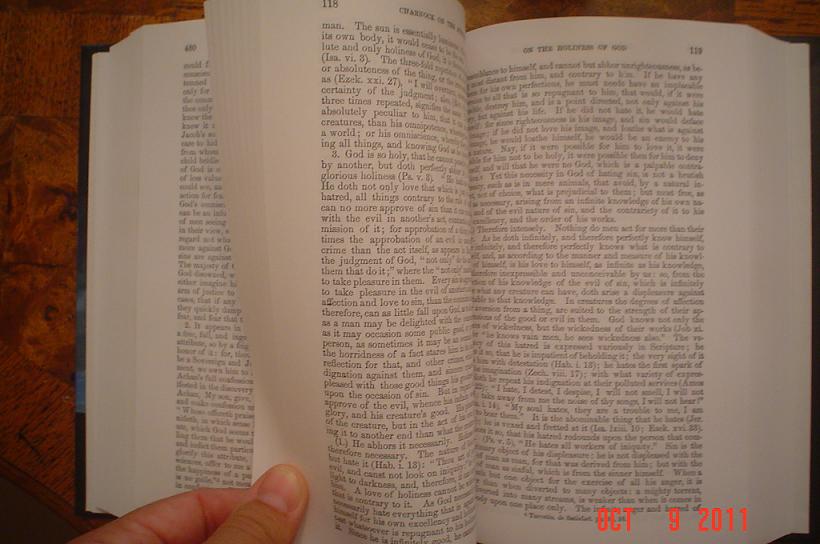
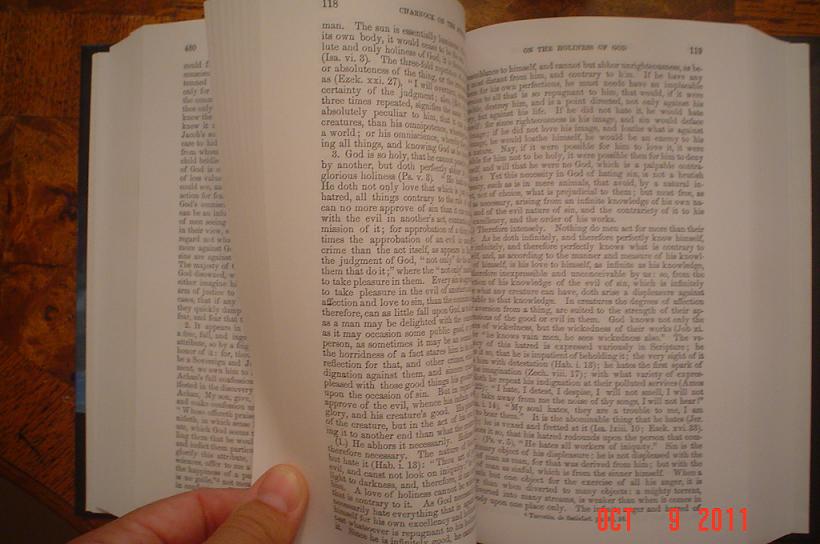
The best way to eat dark chocolate is to bite off a small piece at a time and just suck on it like hard candy. It is too rich to chew and swallow like a Hersheys milk chocolate bar. It must be savored to be appreciated. It must be ingested slowly, for doing so will render the best reward in terms of flavor and energy. It is the same with Stephen Charnock. One page, one section even, at a time is best. It makes one think. It changes one's thinking. When I read Charnock, I find myself thinking things like, It's all so simple. Why didn't I think of that before?

What I'm going to do in this post and the next is give a small sample of Charnock with a bit of commentary just to give you a taste for him--and for Puritan writings in general. Here is the section I read this morning. It is from the second chapter "Discourse II: On Practical Atheism." This discourse starts on page 89 and goes to page 175. Our section begins at the bottom of page 135. Here goes Charnock. We catch him in the middle of something:
II. The second main thing: As man would be a law to himself, so he would be his own end and happiness in opposition to God. Here four things shall be discoursed on.  1. Man would make himself his own end and happiness.  2. He would make anything his end and happiness rather than God.  3. He would make himself the end of all creatures.  4. He would make himself the end of God.
This is what Charnock does. The whole book is outlined in this way. He tells you where you are going and then he takes you there. But before we go, look up at that again. Look at his main point and then the four things he is going to discourse upon to demonstrate his point. The first thing that I notice is his thoroughness. He covers everything there is to cover and from all angles. This is what the Puritans did. They thought things through all the way to the end. The next thing I notice is his depth. There is nothing shallow to his thinking.

The Puritans had no television. They had no entertainment at all in the way that we think of it. They had hard lives and long work days. They had one day off. Sunday. The Sabbath. They spent it in rest, worship, and the contemplation of God. A man like Charnock would have put in a 72-hour work week Monday through Saturday in prayer, study, and attending to the spiritual needs of his flock--before Sunday. He would have spent more time contemplating the things of God in one day than we do in a month. This is why there is so much depth and insight in his writing. They had hard lives and wanted solid answers. We have easy lives and are content with shallow thoughts and empty cliches.

Now let's look at his main point again: As man would be a law to himself, so he would be his own end and happiness in opposition to God.

Human beings were never meant to be independent of God, yet all our thoughts are bent on it, are they not? This is where reading Charnock becomes like reading my own heart and mind. He knows human nature very well, and he learned it, not just from observation, but from Scripture. But let's let him go on, speak for himself.
First, Man would make himself his own end and happiness. As God ought to be esteemed the first cause, in point of our dependence on him, so he ought to be our last end, in point of our enjoyment of him.
Interpretation: Just as we should recognize that God is the source of all we have--life, breath, and all spiritual and physical good, so we should recognize that the pursuit of God and his glory should be our ultimate goal, purpose, and enjoyment.

Are you following yet? Now:
When we therefore trust in ourselves, we refuse him as the first cause; and when we act for ourselves, and expect a blessedness from ourselves, we refuse him as the chiefest good, and last end, which is an undeniable piece of atheism; for man is a creature of a higher rank than others in the world, and was not made as animals, plants, and other works of the divine power, materially to glorify God, but a rational creature, intentionally to honor God by obedience to his rule, dependence on his goodness, and zeal for his glory. It is, therefore, as much a slighting of God, for man, a creature, to set himself up as his own end, as to regard himself as his own law. For the discovery of this, observe that there is . . .
Before we let Charnock go on, let's think about what he said again. Because we are not unthinking animals or plants, but rather rational creatures, then it takes more to bring glory to God than just being. It takes obedience to him, dependence upon him, and zeal for his glory. Every moment we do not exhibit all of these we are in rebellion to him and hurting ourselves.

That last part is my add-in. Not that Charnock would disagree, he just hasn't gotten there yet. He will later in the book. Right now he is concentrating on how we slight and dishonor God with practically every waking moment of our lives.

Though we may not say we are atheists, we live as if there is no God. Instead of obeying him and his laws, we obey ourselves and make our own rule. Instead of depending on him, we imagine that we are dependent on self, that we don't need him. We can live without him. Instead of living for his glory we live for our own. We have set ourselves up in the place of God and live, practically speaking, as atheists. Every day. Nearly every moment. This is our nature. This is what we must turn from when we turn toward God. And this turning from self and turning toward God is something we must do every day.

Monday, October 10, 2011

Stephen Charnock (1628-1680)

I found my devotional for the rest of this year and maybe next. I recently recovered a loaned-out copy of The Existence and Attributes of God by Stephen Charnock. You've heard of Charnock, right? Of course you haven't. That's because he is from a forgotten age. Thankfully, Baker Books didn't forget him, though, and in 1996 they issued a reprint of this classic, two volumes in one. My copy is from the third printing in 2000. I obtained this fine hard-cover tome for the low price of $10 a couple of years back. I see that even a used copy of this is going to run you north of $30 nowadays.

You can learn more about Charnock, if you wish, by going to the Stephen Charnock Project.
There is also the Wikipedia page for all you cyber scholars who just want a quick reference without the burden of complete accuracy -- Stephen Charnock

This is not light reading, and not just because it was written in 17th century prose. Charnock does not skim the surface and give us the highlights. He plumbs the depths and brings forth jewels. This is sustenance for the soul. If you are unfamiliar with Puritan writings they are deeply devotional, not just deep. They are echoes from a time before television, mass entertainment, modern noise.

From the back cover:
"Charnock reflects on Scripture to draw out its full implications for understanding the God of the Old and New Testaments. The practical aim of these meditations is godly living, so that increased knowledge leads naturally to greater obedience and more heartfelt worship."

Volume 1 is 606 pages while volume 2 contains only 524. Since this is not light, I figure it is better to really think and meditate on it than to try to devour large chunks at a time. Ten or twelve pages a week would complete both volumes in about two years. That's not bad. It also leaves me plenty of time for lighter reading. I cannot imagine tackling these two volumes as something that I must complete before moving on to anything else. That would be daunting indeed. Here is an excerpt from last night:
"It must be confessed by all, that there is a law of nature writ upon the hearts of men, which will direct them to commendable actions, if they will attend to the writing in their own consciences. This law cannot be considered without the notice of a Lawgiver. For it is but a natural and obvious conclusion, that some superior hand engrafted those principles in man, since he finds something in him twitching him upon the pursuit of uncomely actions, though his heart be mightily inclined to them; man knows he never planted this principle of reluctancy in his own soul; he can never be the cause of that which he cannot be friends with. If he were the cause of it, why doth he not rid himself of it? No man would endure a thing that doth frequently molest and disquiet him, if he could cashier it. It is therefore sown in man by some hand more powerful than man, which riseth so high, and is rooted so strong, that all the force that man can use cannot pull it up. If therefore this principle be natural in man, and the law of nature be natural, the notion of a Lawgiver must be as natural, as the notion of a printer, or that there is a printer, is obvious upon the sight of a stamp impressed."

Sunday, October 9, 2011

Hallowed Be Thy Name . . . Part 1

It is a rich, old Anglo-Saxon word, replete with color and feeling, much better, I think, than "sanctified." Not that it is any more accurate. "Sanctified" is exactly the word we would use in modern English to translate this Greek word. By the time, however, that this passage of Scripture was being translated into English by King James's chosen scholars the prayer was so firmly set in the minds and hearts of the common people that the decision was made to keep the word "hallowed" intact.

We still use the word nowadays, by the way. You may have once or twice found yourself standing on "hallowed ground" or roaming the "hallowed halls" of some institution or other. And we are all familiar with the pagan festival turned children's excuse to dress up in costume and gorge themselves with candy known as "Halloween" or "All Hallows Eve" or "All Saints Eve" (since it falls on the day before the Roman Catholic "All Saints Day"--November 1).

Hallowed be thy name . . .

What does it mean to hallow something? It means to sanctify it, of course. It means to set it aside or apart as something holy, something special, something above or beyond the mundane. It means to make it holy.

The name of a deity was very important in the ancient world. Recall that when Jacob wrestled all night with the angel of the Lord he asked the angel of the Lord to give him his name, but the angel refused to give it. Recall also that when Moses stood before the burning bush and received his commission from God that he wanted to know a name so that when he returned to Egypt he would have an answer for them when they asked him for the name of the God who had sent him. The name of  a deity was important because it told us something about him.

Note also that in the ten commandments, specifically in the first table of the law which encompasses the first four commandments (those which deal specifically with our actions and attitude toward God), that it is very important that we treat God's name with respect, reverence, and awe:

“You shall not take the name of the Lord your God in vain, for the Lord will not hold him guiltless who takes his name in vain."

Without getting into a discussion of the full meaning of this commandment, let us simply note that God's name is very important to him. He wants it esteemed, respected, hallowed--the opposite of used or treated in an empty fashion.

So let's look at these first few words of the Lord's prayer . . . hallowed be thy name. It is a petition. In fact, it is the first petition of this, our model prayer. How should we pray? What should we request? What should be the first thing on our minds when we approach the throne of God?


Hallowed be thy name.

References to God doing things for his name's sake are all over the Old Testament. In fact, it is saturated with them. Here are a handful if you want to look them up. It is only a small sampling--Psalm 23:3Psalm 25:11Psalm 31:3,  Psalm 106:8Isaiah 48:9Psalm 79:91 Samuel 12:22.

God's name is important to him. I think it is safe to say that God does everything that he does for the sake of his name. But what does that mean?

God's name is his fame. God's name is his reputation. God's name is how he is known to creation.

What is the ultimate charge to be leveled against sinful mankind? What is the ultimate sign of his guilt before a holy God? Is it not that we have sullied his name? As his offspring, what do our actions say about him? Would anyone look at us, at our lives, at our daily failings, and conclude that the God in whose image we were made is holy? The only honest answer is 'no.' And if our daily actions serve to sully his holy name, what right have we to approach Him whom we have habitually offended? None.

Yet he invites us approach him. That, in itself, is grace immeasurable. (How it is possible for God to do this and yet remain holy and just would be the subject of many posts. But to summarize it, it is only because of Calvary.) But make no mistake. When we approach God we are immediately confronted with this, the sum of our crime against him.

Hallowed be thy name.

In approaching him I immediately turn my thoughts away from me and my needs and my wants and turn them toward Him and what he wants. My thoughts and wants and needs are usually trivial in comparison to this . . . hallowed be thy name.

And in this petition we have also a principal that serves to explain why God does what he does in general and why it is he is doing what he is doing specifically in our lives at any given moment . . . that his name might be hallowed.

When we remember that, we change our petition. We may even drop our complaint, you know, the one that brought us before him in the first place.

This is only the first part. In my next in this series we will look at how to apply this petition specifically to our everyday lives. How shall we pray this prayer . . .

Wednesday, September 28, 2011

It's the Same Prayer

I was at a men's Bible study tonight at our church, a study hosted by our Sunday School teacher. We were at the end and about to close with prayer and each one of us was mentioning specific things that we wanted the group to pray about. I mentioned someone I know who is a troubled individual and who needs prayer to be turned and brought back to God. "Are they a Christian?" was asked. "Well, this person made a profession of faith way back when, in childhood, but if you were to ask him now, he would say he doesn't believe in God." Then someone said, "Well, if they really were saved and had the Holy Spirit they wouldn't say that." To which I responded, "I think it is possible that he doesn't really believe what he said, but that he was simply being rebellious when he said it. But either way, it's the same prayer."

Is it not? Think about it.

When an individual apostatizes (leaves the faith) one of two things has happened. Either this is temporary and God by his grace will bring him back. Or this is genuine and his previous profession was a sham. Consider:
1 John 2:19 They went out from us, but they were not of us; for if they had been of us, they would have continued with us. But they went out, that it might become plain that they all are not of us.  
Philippians 1:6 (NKJV) being confident of this very thing, that He who has begun a good work in you will complete it until the day of Jesus Christ;
Just because we are born of him does not guarantee that we will never wander, fail, or fall. But it does guarantee that we will not fall finally if we genuinely belong to him.


So how are we to pray for those who have once made a profession and have now fallen away from it? How are we to know whether or not their profession was genuine? Well, we can't know, not until the end. However, when an individual disavows his profession he should be taken at his word and treated as an unbeliever. How, then, are we to treat unbelievers? We treat them with love, compassion, and truthfulness. How do we pray for them? We pray that God will bring them to repentance and faith, for that is the greatest need that they have.

That is also our need.

We tend to think of salvation in terms of conversion. "I was saved on such and such a day and it happened like this . . ." we would say. If someone were to ask us what one must do to be saved we would tell them one must repent and believe. But repentance and faith are not tools used in conversion and then laid aside. Repentance and faith are daily attributes of the Christian's life. As Christians we are always repenting and believing. Repentance is the state in which we live and belief is the state in which we live. So when we see an individual away from God, away from a state of repentance and faith, we pray that God will bring them to this state whether they have ever made a profession or not.

So the prayer for the wayward Christian is the same as the prayer for the unbeliever, because in practice at least, they are both unbelievers in need of repentance.

It's the same prayer: "Father, take this individual and bring him to the place in his life where he repents of his sin and turns to Christ in faith determined to follow Christ every day till the end of his days."

That prayer is pleasing to God and will work for anyone, regardless of what we think we may know about his spiritual condition. In fact, you could feel free to pray that prayer for me anytime you wanted. As the hymn-writer once penned:
Prone to wander, Lord, I feel it
Prone to leave the God I love.
Take my heart, Lord, take and seal it
Seal it for thy courts above.
Philippians 1:19 for I know that through your prayers and the help of the Spirit of Jesus Christ this will turn out for my deliverance,
Who knows who shall be delivered through your prayers? Or mine?

Thursday, September 8, 2011

Thoughts on Prayer II - God already knows.

Luke 6:7,8 “And when you pray, do not heap up empty phrases as the Gentiles do, for they think that they will be heard for their many words. Do not be like them, for your Father knows what you need before you ask him.
Empty phrases. Meaningless words. Saying the same thing over and over without even really knowing what you are saying. Sounds like what a lot of people do with the Lord's prayer, doesn't it? Think on the irony of that for a moment.

But what is the difference between doing that--repeating the words by rote over and over--and approaching God with one's own flowery formula equally unthought-out, making it up on the fly, without any real clue as to what one should say to God?


The heathen believed that their gods were busy doing their own things and that if one were to get their attention it would have to be done through a virtual flood of words and perhaps some sacrificial bribery. Long incantations would be repeated over and over in the hopes that the god would hear. Likewise, Jewish prayers of the time were full of flowery phrases stated one way, then another way, then a third way, so on and so forth, changed only by a re-ordering of the words in an attempt to either impress God or (more likely) those around them. But we are told not to pray that way.

Why not?
for your Father knows what you need before you ask him.
Sometimes the things that can most radically change the way we think (or in this case pray) are the things that are right there in front of us. We just don't see them.

Of course God knows what we need before we ask him. And as a Father to us he is dedicated to supplying those needs. He knows what we need better than we do and he knows it before we do. Don't miss this last part either. He already plans to give it to us.
Philippians 4:19 And my God will supply every need of yours according to his riches in glory in Christ Jesus.
So there is no need to try to convince or cajole him. It is not our job to persuade God to do something. He knows the need we have for it is he who has given us that need. Likewise it is not necessary to inform him of a situation or predicament. He gave us that situation or predicament.

So then why do we pray? We pray because we need God. Prayer is an act of faith in God and an acknowledgement of God's sovereign care for us. We approach God with the knowledge of his knowledge and wisdom, with a faith in his sovereign goodness toward us (Romans 8:28). Then we humbly ask him to magnify his great name and be true to himself by keeping his promises and being our Father. Prayer is about getting our hearts in line with what God is doing in our lives and honoring him with our faith in him.

"Father, I need you. Thank-you for reminding me of that. You know my need already. I ask that you will supply it according to your riches in glory in Christ Jesus. And do it for your name's sake and your faithfulness. Amen."

That is a biblical, God-honoring, God-pleasing prayer.

All of this does not mean that we do not need to be specific in our prayers. Of course we should be specific. But in the end we do not always know exactly what we need, do we? But God knows. So in the end we always say, "Nevertheless not my will, but thy will be done."

Again, prayer is not about convincing God that he should give us what we want. It is not about informing God of a situation in which he might want to intervene when he would not otherwise have done so. No, prayer is about acknowledging God's greatness in our lives as a Father and our utter dependence upon him for everything.

Wednesday, August 31, 2011

Thoughts on Prayer I - The Right Motivation

I filled in for our Sunday School teacher again the other day and I thought I would make more than one blog post out of the lesson this time. The topic is a very important and also a very practical one--prayer.

I chose the topic as a challenge to me both because I do not pray often enough and also because I have lots of thoughts on prayer which would be beneficial to others if I were to actually coalesce them and present them in an orderly and challenging fashion. This I attempted to do last Sunday and this I will attempt to do here.

I am the worst example when it comes to faith because, while I easily presume upon God's goodness, I am often way too confident in self to actually depend upon God, or recognize the fact that I do. I suffer from a self-deluding conceit. I know as a concept that I depend upon God for everything (as does the entirety of the universe) but in practice I am far too often deluded by self-sufficiency. To a degree all of us are this way (though hopefully you are not as bad as me). This is why God often brings problems into our lives which are beyond our ability to solve. These problems remind us of our need for him.

Back to prayer. If we are going to learn to pray or how or what to pray, the first place we should go is to Christ. This is what the disciples of Jesus did as recorded by St. Luke in Luke's gospel chapter 11:
Luke 11:1 Now Jesus was praying in a certain place, and when he finished, one of his disciples said to him, “Lord, teach us to pray, as John taught his disciples.”
John had taught his disciples to pray in a unique way as his disciples. Jesus's disciples want to know if Jesus has something similar for them--something unique as his disciples.

This is where our ears should perk up. What Jesus is about to teach is not just for them, but also for us, for we are his disciples as well. How should we pray? What should we pray? How often should we pray? How long should our prayers be? All these questions and more will be answered in this passage and in its cousin passage in Matthew 6. Let's look there now.
Matthew 6:5,6 “And when you pray, you must not be like the hypocrites. For they love to stand and pray in the synagogues and at the street corners, that they may be seen by others. Truly, I say to you, they have received their reward. But when you pray, go into your room and shut the door and pray to your Father who is in secret. And your Father who sees in secret will reward you.
First a few quick lessons.

(1) Prayer is not for our own glory. It is not a religious exercise designed to make us look good before others. This type of prayer is not prayer at all, it is pretense. The key phrase is, "to be seen of others." Here Jesus condemns the motivation, not so much the action. Motive is everything.
(2) Private prayer is more important than public prayer. There is a place for public prayer, but as Christians we also need a place for regular private communion with God.
(3) There is a real, heart-felt, genuine faith that motivates us to pray and commune with God. This faith, which comes from God, is the faith that will be rewarded by God.

In the Sermon on the Mount, which is quoted above from Matthew's gospel, Jesus is addressing an audience of self-righteous people. This is why he emphasizes true religious exercise over pretense. He is both teaching about prayer and also condemning their self-righteousness. But over in Luke 11 we have a private scene between Jesus and his disciples and in that passage nothing about the pretense is mentioned, presumably because the sincerity of the disciples was evident in their question.
"Lord, teach us to pray."
Personalize that. I challenge you. Make it your prayer, right now. "Lord, teach me to pray." Both the desire to pray and the knowledge of how to pray correctly come from God.

Sunday, August 21, 2011

Grace in Regeneration

I filled in for our Sunday School teacher a couple of weeks ago and since I put the time in to prepare the lesson and then teach it orally I thought it would not take a lot more effort to put it down here in the blog also just in case anyone is interested.

The question had come up in Sunday School the week before. You know the one. It was (it seems) the eternal question. Did we choose God? Or did God choose us? Election, conditional or unconditional? Our Sunday School teacher came down on the side of unconditional election. God chose us, we did not choose God--at least not until God's grace found us. As a defense for his position he argued that God does not violate human will, that those whom God looks over and does not choose in election are people who reject Christ anyway. They are opposed to God and to Christ. They get what they want. If anyone has a gripe that their will was violated, said he, it would be those who come to Christ, because they were as opposed to Christ as the rest and then came God's grace. They were saved in spite of their initial opposition to God.

Class ended and I called him over and challenged him (just a little) with an assertion. Yes, election is unconditional and based on God's grace alone. No, God does not violate the will of those who are eternally lost. They do get what they want. They are sinners and Christ-rejectors and in the end what they get is the result of their own choices. But God does not violate the will of those whom he saves either.

I let that last statement just sit for a minute. Then I said that what God does, instead, is change their nature.

Keep in mind that I have been here and done this. I have had this debate over and over and over again. In fact, I have argued both sides of it. At one time the argument would get my blood flowing. Now, honestly, I almost want to yawn. But (I thought to myself) this could be an opportunity to offer some clarity to a subject that can sometimes seem very muddy.

So my Sunday School lesson was topical and the topic was regeneration. My initial Scripture reference was John 3:
Now there was a man of the Pharisees named Nicodemus, a ruler of the Jews. This man came to Jesus by night and said to him, “Rabbi, we know that you are a teacher come from God, for no one can do these signs that you do unless God is with him.” Jesus answered him, “Truly, truly, I say to you, unless one is born again he cannot see the kingdom of God.” Nicodemus said to him, “How can a man be born when he is old? Can he enter a second time into his mother's womb and be born?” Jesus answered, “Truly, truly, I say to you, unless one is born of water and the Spirit, he cannot enter the kingdom of God. That which is born of the flesh is flesh, and that which is born of the Spirit is spirit. Do not marvel that I said to you, ‘You must be born again.’ The wind blows where it wishes, and you hear its sound, but you do not know where it comes from or where it goes. So it is with everyone who is born of the Spirit.”
A new birth, Jesus proclaims, is a prerequisite to entering Christ's kingdom. Unless one is born again, he cannot see the kingdom of God. But what does this mean? This is Nicodemus's question and we are glad he asks it because we are wondering also. Jesus explains that this new birth is a spiritual birth, that one is born into God's kingdom. Just like the wind, this new birth is something that is only seen through its results, through the effects it has on individuals.

It is interesting that Jesus uses a birth analogy to explain what happens to a person when he is "saved." There are two other analogies used in the New Testament which are similar. They are creation and resurrection.

We have seen an example of the birth analogy in the passage above. Here is an example of the resurrection analogy. Ephesians 2:
And you were dead in the trespasses and sins in which you once walked, following the course of this world, following the prince of the power of the air, the spirit that is now at work in the sons of disobedience— among whom we all once lived in the passions of our flesh, carrying out the desires of the body and the mind, and were by nature children of wrath, like the rest of mankind. But God, being rich in mercy, because of the great love with which he loved us, even when we were dead in our trespasses, made us alive together with Christ—by grace you have been saved— and raised us up with him and seated us with him in the heavenly places in Christ Jesus, so that in the coming ages he might show the immeasurable riches of his grace in kindness toward us in Christ Jesus. 
And here is an example of the creation analogy. 2 Corinthians 5:
17 Therefore, if anyone is in Christ, he is a new creation. The old has passed away; behold, the new has come. 18 All this is from God, . . .
Notice something about these three comparisons? In all three God is active and we are passive.

A creature cannot create itself. It may pro-create, but it cannot create . . . itself. It did not dictate the terms of its creation, the time, the place, nothing. It simply wakes up one day and is.

A dead man cannot resurrect himself. Lazarus, in the tomb, will stay there until judgment day. There is nothing he can do about his condition. He has no power over death. He has no power even to wish for new life. He is dead. If he is brought back to life it will be on Jesus's terms, when and where Jesus chooses. Lazarus is passive. Did Lazarus awake and then hear Jesus's voice calling him from the tomb or was it Jesus's voice that awakened him? In the end, it doesn't even matter, for without Jesus's voice there is no resurrection for Lazarus. But, and don't miss this, there was only one man raised from the tomb that day and it was the one Jesus chose to raise. Resurrection is something in which we are passive, not active.

It is the same with birth. When were you born? Where were you born? Now, here's a silly question. Why? Why did you choose to be born in the year you were born in? Why not wait? Why not choose an earlier date? Why be born where you were born? I imagine that there are multitudes of people born into horrid places in this world who could wish they had been born elsewhere. But we had no choice, did we? We were only passive in our birth, not active.

And that is the point of using these analogies. Until God regenerates us, until God creates us anew in Christ, until God raises us to walk in new life, we will never desire him, we will never desire righteousness, we will never desire holiness. But when God regenerates us, when he creates us anew, when he gives us new life in Christ, then we are new creatures with new natures and new desires. Then we awaken and choose him.

A dead man cannot breathe, but a living man breathes. Likewise a man who is dead in trespasses and sins cannot believe, but a man alive in Christ believes. Before God's grace, and apart from God's grace, we want nothing to do with God, not the true and living God. We may take an idol to ourselves if we find that convenient, but we are self-centered and self-serving and want nothing to do with the spiritual truth and true holiness that confronts us when we come face to face with the living God. We are at enmity with God, according to Paul in Romans 8. We are hostile toward him. This is true of everyone apart from grace. This is our fallen nature.

This is why God must change our nature, and when he does so, we turn to him.
James 1:18 Of his own will he brought us forth by the word of truth, that we should be a kind of firstfruits of his creatures.
1 Peter 1:3 According to his great mercy, he has caused us to be born again to a living hope through the resurrection of Jesus Christ from the dead,
John 1:13 who were born, not of blood nor of the will of the flesh nor of the will of man, but of God. 

The implications of this, and there are many, I will leave for another time. For now, suffice it to say that it takes a miracle of grace to save a sinner and what we are asking God for, and what we are expecting from God when we proclaim his gospel, is that miracles will take place. But take heart. God has promised these miracles and it is for this reason that Christ came.

Sunday, July 3, 2011

Christian Conversation With Unbelievers

I use the word "conversation" in the title of this post because it has a common usage in everyday language and a different usage in Scriptural context. In everyday language it means informal communication between people. In a Scriptural context it refers to our everyday comportment before others, i.e. how we live. I want to discuss it in both contexts.


I got to thinking about this because of an incident that took place on my facebook page. I was having an informal discussion with a friend of mine who is an unbeliever and we were discussing the definition of faith, its nature, and its relation to reason. We did this in the context of theoretical physics and the worldviews that underlie our thinking. We did not solve anything with our discussion, but I think progress was made in that each side probably increased in understanding of the other. Having said that, toward the end of the conversation another friend jumped in who is a believer and engaged my unbelieving friend in an entirely different mode and attitude. A third friend, who is also a believer, expressed embarassment at what the second friend was bringing to the conversation. The second friend was quite confrontational in style. A virtual food fight ensued and I have to admit that it was quite entertaining. But it was also . . . not good. I had initial reactions, but I held them in check wanting to think about it some more in order to be able to respond in the best way possible. Everyone involved is a friend and none of us is perfect, but in the final analysis I do not think it would be prudent for me not to say anything at all about what I saw as an entirely wrong way for any believer to approach an unbeliever with the truth of Christ. The Scripture has much to say about the subject and, as believers, the Scripture is our rule of faith and practice. So here goes.

I initially thought of about a half dozen Scriptures which admonish the believer to humility and grace in attitude when presenting the truth claims of the gospel to the world.

For example, in Ephesians 4 we are admonished to speak "the truth in love." In Colossians 4 we are told, "Let your speech always be gracious, seasoned with salt, so that you may know how you ought to answer each person." In Philippians 2 we are told, "Do nothing from rivalry or conceit, but in humility count others more significant than yourselves."

What should we think about this? Well, for starters, if our truth claims are correct then love compels us to share this truth with others in the hopes that they also will be brought to a knowledge of the truth. If ultimate joy, and the highest humanity, can only be brought about through submission to and reconciliation with God--and as Christians we believe this--then we are compelled by love to go out and lovingly proclaim the gospel to those who are not a part of our Christian community. But how we do this is as important as doing it. We must be careful in our conversation with those who are without that we do not soil the truth we proclaim by proclaiming the opposite message with our other conversation.

If we believe we are saved by grace, then grace must be more than just the message we proclaim, it must also describe our attitude while proclaiming it, and our life as we live it. It's ridiculous to think we can verbally smack people into faith in Christ. Our speech is to be always with grace, only seasoned with salt. We are to speak the truth in love. Everything we do is to be done in humility, not pride, not conceit.

What makes us to differ? As Christians, what do we believe makes us to differ from unbelievers? Are we better than they? The answer is "no." Smarter? No. Wiser? No. Then how do we differ? Someone might answer with "faith." But why is it we believe when others do not? Is it because we are morally or spiritually superior? Not in any way. The biblical answer is "grace."


That's it. Grace. Period.

Knowing this should humble us, not swell us up with pride. It should cause us to speak truth in love and pray for God to use his truth to change hearts and minds. It should not cause us to be haughty or arrogant.

In 1 Peter 3, Peter said it well:
Finally, all of you, have unity of mind, sympathy, brotherly love, a tender heart, and a humble mind. Do not repay evil for evil or reviling for reviling, but on the contrary, bless, for to this you were called, that you may obtain a blessing. For
“Whoever desires to love life
and see good days,
let him keep his tongue from evil
and his lips from speaking deceit;
let him turn away from evil and do good;
let him seek peace and pursue it.
For the eyes of the Lord are on the righteous,
and his ears are open to their prayer.
But the face of the Lord is against those who do evil.”

Now who is there to harm you if you are zealous for what is good? But even if you should suffer for righteousness' sake, you will be blessed. Have no fear of them, nor be troubled, but in your hearts honor Christ the Lord as holy, always being prepared to make a defense to anyone who asks you for a reason for the hope that is in you; yet do it with gentleness and respect, having a good conscience, so that, when you are slandered, those who revile your good behavior in Christ may be put to shame. For it is better to suffer for doing good, if that should be God's will, than for doing evil.
Being an imitator of Christ is an unreachable goal for a fallen human being, but it is the goal we are to strive for in all our conversation as Christians. Only by God's grace can it be achieved. Let us daily petition God for a better attitude and for Christian grace in all that we do.